 Image 1 of 1
hese are an attractive and peaceful cichlid that loves a well oxygenated planted aquarium.
Jewel Cichlid’s comes from the fast-flowing River Congo and some of its tributaries in central Africa.
Normally peaceful but will be territorial and aggressive when breeding (like most cichlids) and can be kept with many medium sized and active community fish such as Congo Tetras and Tiger Barbs.
This specie will tolerate a wide range of conditions with pH levels of anywhere between 6.0 and 7.8.
These require an aquarium of at least 80cm (preferably larger) is recommended with a few large rocks and lots of plants on a sand or gravel substrate.
Feed a mix of flakes, pellets, and frozen tropical foods.
Common name(s):
Red Jewel Cichlid.
Scientific name:
Hemichromis lifalili.
Other names:
Rubricatochromis lifalili.
Family:
Cichlidae.
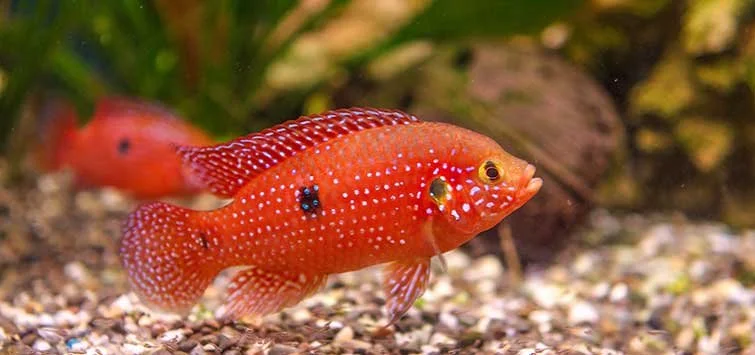
Colour:
Blue and red.
Native habitat:
Congo River and tributaries.
Potential lifespan:
7 years.
Maximum size (approx.):
Up to 10cm.
Degree of difficulty to keep:
For slightly more experienced fishkeepers.
Swimming level:
Lower areas of the aquarium.
Breeding:
Egg layer.
Sex:
Males are more intensely coloured than females.
Temperature:
22-24°c.
Water parameters:
pH: 6.0-7.8.
hardness 2-12°dGH.
Feeding:
Flake food when small, then a mix of vegetable and omnivorous pellets (Hikari Cichlid Excel or Cichlid Gold).
Frozen and live foods including Bloodworms, Daphnia, and frozen Tropical Mix.
Minimum aquarium size:
80cm long.
70 litres.
Cohabitation:
Can be kept singly, as pairs or in groups.
Will be territorial and intolerant when breeding.
Suitable to keep with medium to large active community fish such as Barbs, Tetra’s, Giant Danios, Synodontis catfish or with other fish of similar size or temperament.
Other tips and information:
Like all cichlids, these fish will be territorial and aggressive when breeding.
Good filtration and oxygenation is essential.
Provide a strong current with calmer/still areas.
Will not eat plants but may move them.
Will dig the substrate behind large rocks to lay eggs.
hese are an attractive and peaceful cichlid that loves a well oxygenated planted aquarium.
Jewel Cichlid’s comes from the fast-flowing River Congo and some of its tributaries in central Africa.
Normally peaceful but will be territorial and aggressive when breeding (like most cichlids) and can be kept with many medium sized and active community fish such as Congo Tetras and Tiger Barbs.
This specie will tolerate a wide range of conditions with pH levels of anywhere between 6.0 and 7.8.
These require an aquarium of at least 80cm (preferably larger) is recommended with a few large rocks and lots of plants on a sand or gravel substrate.
Feed a mix of flakes, pellets, and frozen tropical foods.
Common name(s):
Red Jewel Cichlid.
Scientific name:
Hemichromis lifalili.
Other names:
Rubricatochromis lifalili.
Family:
Cichlidae.
Colour:
Blue and red.
Native habitat:
Congo River and tributaries.
Potential lifespan:
7 years.
Maximum size (approx.):
Up to 10cm.
Degree of difficulty to keep:
For slightly more experienced fishkeepers.
Swimming level:
Lower areas of the aquarium.
Breeding:
Egg layer.
Sex:
Males are more intensely coloured than females.
Temperature:
22-24°c.
Water parameters:
pH: 6.0-7.8.
hardness 2-12°dGH.
Feeding:
Flake food when small, then a mix of vegetable and omnivorous pellets (Hikari Cichlid Excel or Cichlid Gold).
Frozen and live foods including Bloodworms, Daphnia, and frozen Tropical Mix.
Minimum aquarium size:
80cm long.
70 litres.
Cohabitation:
Can be kept singly, as pairs or in groups.
Will be territorial and intolerant when breeding.
Suitable to keep with medium to large active community fish such as Barbs, Tetra’s, Giant Danios, Synodontis catfish or with other fish of similar size or temperament.
Other tips and information:
Like all cichlids, these fish will be territorial and aggressive when breeding.
Good filtration and oxygenation is essential.
Provide a strong current with calmer/still areas.
Will not eat plants but may move them.
Will dig the substrate behind large rocks to lay eggs.